Given the split nature of the Federal Open Market Committee (FOMC) vote in December—two members voted for no change, and one voted for a 50-bps decrease—committee members are sending mixed signals to depositors on the future of deposit rates.
With the FOMC meeting next week on Jan. 27–28, professional investors expect no change in rates from the FOMC this month, according to CME Group. And yet, employment data is stronger now than a month ago, inflation is still not down below the Federal Reserve’s 2.00% target, and GDP forecasts are very strong.
Depositors could not be blamed for wondering:
- Is now the right time to use a certificate of deposit (CD) to lock in an interest rate—potentially for the long term?
- What would a “good” rate be for funds locked in a time investment, such as CDs or U.S. Treasuries?
In December, the Fed moved the interbank overnight rate down to a range of 3.50% to 3.75%. Markets pretty clearly expect no change in rates next week. Waiting to open a CD is not likely to provide a benefit, but choosing well when selecting a term could. Current bank and credit union rates for certificates are strong relative to U.S. Treasuries of similar term, especially for maturities of a year.
Going longer than 12 months comes with risk (but also potential reward), as the economy is now the wild card in the future path of deposit rates. Currently, employment and GDP growth are not showing a clear need for stimulus. Inflation is also showing it may not be transient.
Today’s Rates: A Look at the Listings on CD Valet
Institutions offer rates for 12 months that currently beat U.S. Treasury rates, according to CD Valet’s Market Intelligence Tool. A 12-month T-bill yielded 3.55% on Dec. 16; a 24-month note yielded 3.59%.
The top three banks—Credit One Bank N.A.; Morgan Stanley Private Bank N.A.; and Farmers Bank in Tennessee—are now offering rates of 4.07% APY* or more for 12-month CDs.
The top three credit unions—Daniels-Sheridan F.C.U. in Montana; Best Financial Credit Union in Michigan; and Scott Associates Credit Union in Ohio—offer rates at or above 4.85% APY*. Visit CD Valet for the most current rates or to find rates available near you.
Given that a rate higher than 4.00% APY is still a very strong offer for a CD, some depositors are moving now to lock in for terms of a year or less.
Here’s the economic perspective that informs a decision like that.
Economic Outlook: Strongly Differing Views
The Federal Reserve focuses on maximum employment and price stability when determining monetary policy.
Depositors might recall that the December rate cut was preceded by weeks in which no economic data was collected. Now, we know that inflation is still elevated, unemployment data is trending down, and GDP forecasts are exceedingly strong. The U.S. economy is showing a fair bit of strength, even to the point of being overheated.
Chair Jerome Powell said after the December cut that the FOMC needed to “see how the economy evolves,” which CNBC noted was a similar statement to the one made by Powell the last time he “signaled that the committee likely was done cutting for the time being.”
Savers looking to maximize yield may want to consider terms that provide the absolute best yield, and they may also want to investigate what yields a longer term would provide. Repricing CDs at their maturity is becoming more important to preserving yield over time. Here’s why.
Stubborn Inflation: May Motivate Rate Increases at Some Point
The Consumer Price Index for All Urban Consumers increased 0.30% on a seasonally adjusted basis in December, the U.S. Bureau of Labor Statistics (BLS) reported on Jan. 13.
Over the last 12 months, BLS’ index for all items also increased 2.70% before seasonal adjustment. The index for shelter rose 0.40% in December and was the largest factor in the “all items” monthly increase. The index for energy rose 0.30% in December. The index for all items less food and energy rose 0.20% in December.
“The most important thing facing us is we’ve got to get inflation back to 2.00%,” Austan Goolsbee, Chicago Federal Reserve Bank President, told CNBC. He cited concerns over rising costs and affordability. The labor market also appears to be stabilizing.
Employment: Not Showing Need for Support
The latest Labor Department report on claims for jobless benefits shows such filings are down considerably since Dec. 6. The Jan. 10 report showed 198,000 claims—the second-lowest weekly total in the past 12 months. The most recent peak was 237,000 claims on Dec. 6, still well below the year’s high of 264,000 on Sept. 6.
While January 2026 unemployment data is not yet available, the Federal Reserve Bank of St. Louis reported a decline from November to December 2025, from 4.50% to 4.40%. That’s not a large move, but 4.40% unemployment is not high by historical standards.
GDP: Showing Growth Not Stagnation
The Federal Reserve Bank of Atlanta’s GDPNow model now estimates real GDP growth for 2025 (seasonally adjusted annual rate) at 5.30% for fourth quarter 2025 as of Jan. 14, up from 5.10% on Jan. 9.
The upward move in the GDPNow forecast reflects growth in personal consumption expenditures, private domestic investment, and government expenditures.
Bottom Line
The U.S. economy is not showing signals consistent with lower rates:
- The employment picture has improved.
- Concerns remain about non-transitory inflation.
- Projections for GDP are quite strong by historical standards.
For CDs, which have a fixed term and a locked-in rate, the question most savers ponder is: Open a CD now or wait? Waiting to open a CD likely has more downside risk to yield than upside, as we reported in prior months.
A helpful perspective: Today’s rate environment leaves more room for change ahead. That makes it practical to ask one key question when opening a CD: What might deposit rates look like when this CD matures?
Many depositors now choose shorter maturities of 12 months or less because of higher returns than U.S. Treasuries. Consider reviewing current 12-month CD rates from featured banks or credit unions near you or nationwide.
Stay ahead of rate changes and find the best CD opportunities nationwide with CD Valet.
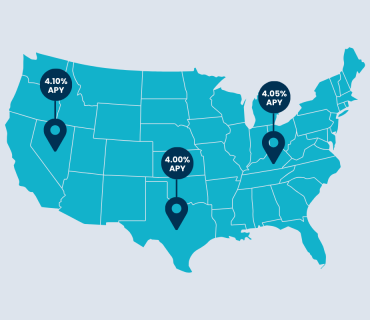
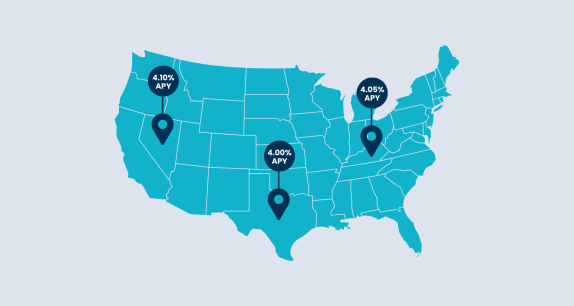
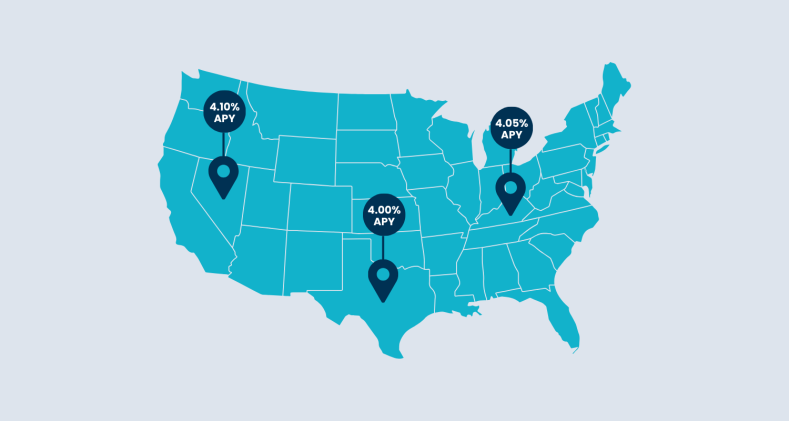
Explore our Best CD Rates by State interactive map, updated daily, to see how rates compare where you live — or visit our new Best CD Rates page, updated monthly, for a quick snapshot of the highest CD rates available right now across banks and credit unions.
*Annual Percentage Yields (APY) not offered by CD Valet but based on data from various institutions as of 01/22/26 and subject to change. Early withdrawal penalty may apply. Fees may reduce earnings. Additional restrictions may apply.